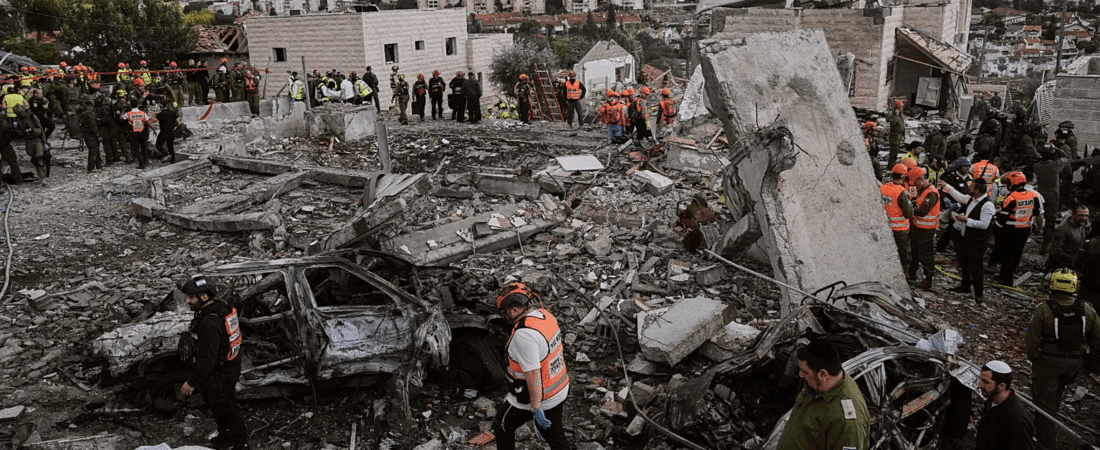
There have been heightened tensions between the US and Iran because of a series of military confrontations and counter-military actions that have taken place in the Middle East. This new development is a marked escalation in what was a relatively peaceful period in the conflict.
This new conflict has also seen the involvement of countries housing military bases of the US.
Iran Reports Missile Attacks on U.S. Forces in the Region
The Iran Revolutionary Guards Corp has announced that they fired several ballistic missiles at two U.S. military air bases in Jordan. The state-controlled press in Iran claimed that there was considerable damage from the attacks.
The armed forces of Jordan stated that they managed to intercept eight ballistic missiles but did not specify who had launched them.
It was further revealed that the Iran military also fired missiles at an American air base located in the UAE, where they targeted the U.S. military personnel.
U.S. Conducts Strikes on Iranian Rocket Launchers
The most recent attacks from Iran occurred after the U.S. had military operations against Iranian troops.
The U.S. announced that airstrikes had been conducted on Iranian rocket launchers stationed on Larak Island, which is in the Strait of Hormuz. The U.S. authorities claimed that these rocket launchers were being prepared for a military operation using rockets and sea mines.
Strait of Hormuz is an important shipping route for the world’s oil industry. Increased tension between the U.S. and Iran has also caused some concern about possible effects on shipping, energy production, and world markets.
Regional Allies Face Increased Pressure
This resurgence in military action has created further pressure on U.S. allies in the Middle East.
Both Jordan and the United Arab Emirates have ties with the U.S., but at the same time, both countries have their own vested interests in maintaining regional stability. This is shown by the attacks that have occurred during rising tensions between the United States and Iran.
Governments in the region need to balance issues related to security and avoid an escalation of this conflict into a more widespread one.
Iran’s President Heads to a Regional Summit
Masoud Pezeshkian, president of Iran, was scheduled to take part in the summit of the Shanghai Cooperation Organisation amid the changing military situation.
The group consists of several key players of the region and aims at enhancing cooperation between its members and partners. President of Russia, Vladimir Putin, was scheduled to have talks separately with Masoud Pezeshkian and President of China, Xi Jinping.
The diplomatic talks may open the door for talks on the conflict and other issues.
Washington Pursues Economic Pressure on Tehran
Military action is taking place amid a growing U.S. effort that seeks to intensify the economic pressure on Iran.
U.S. Treasury Secretary Scott Bessent will likely use his meetings with G20 partners to press his case for isolating Iran economically. The U.S. government has cautioned nations and financial institutions about the possible repercussions of supporting operations that Washington says have helped Tehran.
The policy involves the combination of financial pressure and military action, adding to the uncertainty of doing business in the region.
Iran Calls for Regional Unity
Iran’s Supreme Leader Mojtaba Khamenei has urged Muslims in the region to come together to fight against the US and Israel.
This is an indication of how Tehran is seeking to present the issue as a regional battle and not just between the US and Iran.
This kind of rhetoric could make things even more difficult for diplomacy, especially since neighboring countries seek to safeguard their interests.
Financial Institutions Face Additional Scrutiny
This dispute is also impacting the finance industry.
The Central Bank of the United Arab Emirates has conducted a special investigation into the activities of Banque Misr, an Egyptian government-owned bank that operates in the UAE. This investigation was carried out as a result of actions taken by the U.S. concerning this bank and the U.S. efforts to close down financial avenues that might help Iran.
Other financial institutions in the Middle East region may come under greater scrutiny because of this situation.
What the Escalation Could Mean for the Region
The recent round of attacks serves to illustrate the potential that there may be repercussions of the U.S.-Iran dispute outside the direct countries involved.
U.S. military bases and troops are stationed in many Middle Eastern countries, while Iran has connections within the region as well. In this case, any further actions might serve to pose threats to the security of surrounding nations.
The Strait of Hormuz is also of considerable importance due to the role it plays in international energy markets. The further continuation of military operations in the region poses threats to shipping and markets.
Conclusion
The new U.S.-Iran conflict has escalated to a dangerous level in which the U.S. attacks have been reciprocated by Iran through launching attacks against U.S. military positions in the region. The inclusion of sites in Jordan and the UAE highlights the security consequences of the conflict.
Apart from military actions, the U.S. government is escalating economic pressure on Iran, whereas the Iranian government is trying to unite more in the region and diplomatically engage with nations such as Russia and China.
The next few weeks will be critical in establishing whether the new escalation will continue or will develop into a regional conflict. Diplomacy, regional cooperation, and decisions made by both the U.S. and Iran will be crucial in deciding the future.
FAQs
The latest escalation followed U.S. strikes against Iranian rocket launchers, after which Iran reported missile attacks targeting U.S. military facilities and personnel in the region.
The Strait of Hormuz is a major international shipping route for energy supplies. Military activity in or around the waterway could affect commercial shipping and contribute to uncertainty in global energy markets.
There is a possibility of wider regional consequences because U.S. military forces operate from bases in several countries and Iran has relationships with regional actors. Continued attacks could increase pressure on neighboring governments and raise the risk of further escalation.